
Announcement
IELTS Laboratory: a bespoke IELTS LMS and dynamic online Speaking and Writing textbook
What is IELTS Laboratory?
IELTS Laboratory is an online course and dynamic textbook for IELTS Academic Writing and Speaking, with teacher marking built in, so every mistake you identify becomes a lesson centred on your student's own writing.
It is not a plugin, and not a course shoehorned into a random LMS. It is a bespoke learning management system built from the ground up. The beta is open now, and we'd love to have you be part of it.
Key facts
Who it is for: IELTS teachers and their students.
What it covers: IELTS Academic Writing and Speaking. Academic only.
How it works: students complete a unit, you mark it, and the portal builds lessons from each student's own mistakes.
Where it runs: in a web browser, and in the IELTS Laboratory app for Android.
Price: free to sign up and try the materials. For students you bring yourself, it is $19 a month per student, only in months when that student has a paid lesson.
Lesson fee: for students who find you through the teacher directory there is no monthly fee. IELTS Laboratory takes 90% of the first paid lesson with you, then 15% of later lessons (and 15% of rideshare seats). Lessons are paid through your own Stripe account.
Joining: you give your students your Teacher ID (mine is just "will"), they sign up and connect to you with it, and their work appears in your list.
Privacy: students' work is stored mainly in the EU, and the AI that builds lessons runs mainly in the EU too.
Who built it: Will Salisbury, founder of IELTS Laboratory. I've been through IELTS Speaking examiner training, and the Writing course has been edited by a former IELTS Writing examiner.
Why I built it
I've been teaching IELTS on Preply for a few years now, and for longer than I care to admit I found myself waiting for someone to build a platform that would a) give teachers a unified online course to teach from, b) provide one place for all their students' work, and c) implement up-to-date tools for practising Writing and Speaking. In the end, I decided to build it myself.
Over the years I'd designed a lot of my own materials: lessons, model answers, exercises, speaking tasks. They worked, but they were scattered across folders and documents, and so was everything else. Essays arrived in my email, on WhatsApp, in Google Docs, in whatever the student happened to use that week. My marks lived in one place, the student's rewrite in another, and last month's feedback was forgotten somewhere at the bottom of an inbox.
Speaking was even harder. A student would send a recording over via Preply, I'd listen and reply with notes, and then it was gone. No steady record of their progress. Nothing we could both open, point at and say "this is what to work on next", or "look how far you've come".
What I wanted was simple: one place, one course, one shared copy of the work that the student and I could both see.
So that's what I built. Before Preply, I taught on a number of different platforms across higher education institutions; along the way I picked up just enough technical skills to think about building my own, and a long list of what I thought those platforms were missing.
IELTS Laboratory is that list, finally in one place, with the latest iterations of learning materials I've been using over the years brought together at last into one coherent course. We've tried to make it true to what we think students need, without any stocking fillers.
And, it hasn't been built in a vacuum. It has been developed through using it with real students, and a lot of the features you'll read about below exist because a student asked for them.
An online course, not a folder of unorganised material
This is the heart of it: a proper course that lives online, that you and your students both open, and that you work through together.
Every lesson in one place. Writing and Speaking, in a clear order, with each step building on the last.
Flipped learning, built in. Students complete the unit between your lessons. You mark it, and when you meet, you talk it through together, so class time goes on discussion and practice, not on ideas they could have read at home and thought through in their own time.
Interactive, not just text. Every learning resource has something for the student to do: drag a paragraph into shape, link ideas into a logical chain, record an answer, try the quiz.
You can see where every student is. At a glance you know which lesson they're on, what they've sent and what comes next.
Two channels. Every student follows the standard course. On top of that, your marking gives our AI what it needs to build personalised lessons around each student's own mistakes. The course teaches everyone; your feedback makes it personal.
Writing and Speaking, one course
They're the two parts of IELTS where the candidate has to produce English, so the course treats them as one. The paragraph structure a student learns for Task 2 is the same thinking they use to extend a Part 3 answer. The grammar point they meet in a writing unit comes back in a speaking lesson.
A course that never stands still
Through intervention analysis, the course is tweaked constantly from what learners actually do. Every mistake a teacher marks is tracked with a coding system inspired by my EdD research. Grammar and vocabulary errors use the same codes in Writing and Speaking, so we can see when the mistake in a student's essay is the same one they make when they speak, and which mistakes keep coming back across every student.
We also track which lessons get opened, which questions students get right first time, and whether a mistake comes back after the lesson that was meant to fix it. When a lesson isn't working, we change it. When teachers keep marking a mistake that has no lesson yet, we write one. Most courses are written once and never touched again without monitoring how effective they are. This one is designed to improve over time, based on real learner usage.
The thinking behind it
None of this is new pedagogy. What is new is having it all in one place, joined up. A few ideas run through the whole course:
Flipped learning. Input happens before class, so the time you spend together goes on the things that need a teacher: discussion, questions and feedback.
Product and process writing, combined. Students study a model answer and see how each sentence does its job, the product approach. Then every essay goes through drafts: they write, get feedback, rewrite and compare with the model, the process approach. A clear target, and a real process for reaching it.
Assessment for learning, and needs analysis that never stops. Marking isn't a verdict at the end, and needs analysis isn't a placement test at the start followed by guesswork. Every marked mistake, every pronunciation problem and every hard word adds to a live picture of what each student needs, so the next lesson is always aimed at where they are now.
Design-based research. The course itself is refined in cycles: real students use it, the data shows what works and what doesn't, and the lessons are changed and tried again.
Noticing. Students learn most from seeing the gap between what they wrote or said and what they meant to say. That's why lessons are built from their own sentences, and why the speaking transcripts highlight every word.
Scaffolding. Structure first, then language. Students play one of our games to get the hang of paragraph writing, putting the parts of a paragraph in order, then they try writing their own. The support comes away as they get stronger.
Retrieval practice. Flashcards, quizzes and the word lists bring mistakes and new vocabulary back until they stick, with the hardest words always at the top.
For teachers: you mark, the portal does the rest
Highlight the words, make a card, mark on your phone. Select the student's own words on their essay and make a flashcard on that exact mistake. Teachers aren't always at their desk, so we put marking on phones. You can be watching Netflix, mark an essay quickly on your phone, and send personalised lessons before the episode ends. You highlight the error, write the correct version and the explanation, and AI adapts a lesson from our resource bank using their own words.
Bands, the simple way. A whole number for each criterion, and the portal works out the overall. Add your general feedback and next steps, press Send, and the student is told their feedback is ready instantly.
Write on the same essay, at the same time. After you mark, you and your student open the same live copy of the essay and work on it together. It's like a shared OneDrive document, except nobody has to set it up, send a link or remember where it's saved. Every copy is stored automatically inside the course, so you can both go back to it next week, next month or the day before the exam.
See what your student sees. One tap on a student's name shows you their screen. No guessing what "I couldn't find it" means.
In-class lessons, ready when you are. The portal groups the mistakes you marked across your class and builds an in-class lesson around them: slides that name each grammar point and teach it with fresh examples, and an AI-written class puzzle, a new essay with those mistakes planted in it for students to find and fix. You edit it so it's yours, then run the puzzle live inside the course, with students working individually or in small groups. At the start of a class the work is sent to every student's device, so you can use it in face-to-face teaching too. The AI cloning and compiling of mistakes serves the dual purpose of not putting individuals on the spot (only they see their own work), and gives them opportunity to spot the errors in a different context.
You know when work comes in. One email per new essay, and a short "Needs marking" list.
Get found by new students. A teacher directory where you can advertise your teaching, with an intro video of up to three minutes. Students find you, book your classes, group or private, and pay through your own Stripe account. For students who find you this way, IELTS Laboratory takes 90% of their first paid lesson with you, then 15% of later lessons.
Inside the course: what students work through
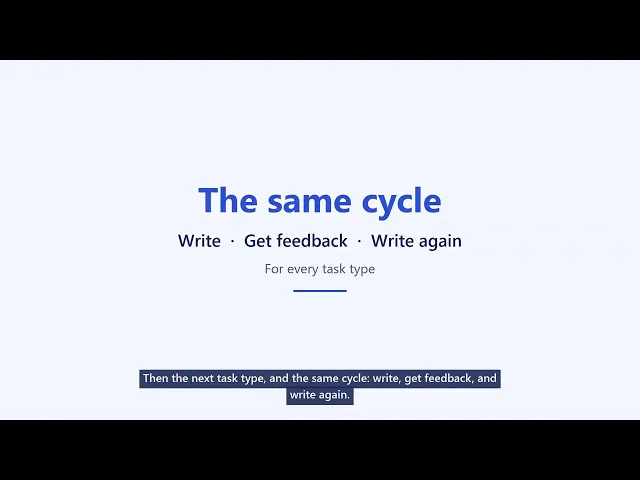
A unit for every Task 2 essay type and every Academic Task 1 question type. Draft 1 → the lesson → teacher feedback → rewrite → Draft 2 → teacher feedback → rewrite → final report. The lesson opens the moment Draft 1 is sent.
See the structure. A page that maps the student's own essay paragraph by paragraph, each box turning green when it's complete and red when something is missing. Students finally see what "your paragraph lacks development" means, in their own work.
Build it, then write it. Students drag the parts of a body paragraph into place, then write their own. Structure first, then the language to fill it, with grammar and vocabulary taught right at the sentence where they're needed.
A final report worth sharing. Every draft's band, the change between them, and a line graph of progress.
Vocabulary that adapts. Lists of useful vocabulary, with the words a student finds hardest shuffled to the top, plus the most common English words, the New Academic Word List, and grammar and vocabulary games.
Speaking: record anywhere, and see and hear every word
This is the part I'm most excited about. I did my MA research on spoken English, and the thing candidates need most is to practise out loud. So recording is everywhere:
Speaking lessons built around Part 2 and Part 3 questions.
An interactive AI interviewer for Part 3. A real back-and-forth discussion, the way Part 3 actually feels on the day.
Delivered to you with karaoke highlights. Each recording comes with the transcript lighting up word by word as it plays, so giving feedback is natural: you just highlight and create flashcards, as with Writing.
Pronunciation tracked on every recording. We wrote our own code to track each student's pronunciation problems and send them to the lessons for their three biggest ones, many with moving graphics of the mouth. You can see the problems too, so you know what to work on before class.
Final speaking tests: four full Part 2 and 3 tests, which you review as their teacher.
Your language: pages on the typical pronunciation problems of speakers of eight languages, from Arabic to Korean. (Yes, the th finally makes sense.)
The Android app
The IELTS Laboratory app for Android puts the whole course on the phone, with notifications when feedback is ready.
Where AI is used, and why the teacher comes first
There's AI in IELTS Laboratory, but only where it helps: it builds lessons from our lesson bank and personalises them for each student, and it runs the Part 3 interviewer. But I built it specifically around the teacher, because the relationship between a teacher and their students can't be effectively emulated solely with AI. The little things we teachers notice, combined with the strategies we have learned along the way, are unique to each of us. This course doesn't try to replace that. It takes away the repetitive bits, building every lesson from scratch, chasing voice notes across three apps, the "where did I put that essay", so you can spend your time on the part only you can do.
Questions and answers
What is IELTS Laboratory?
IELTS Laboratory is an online course and dynamic textbook for IELTS Academic Writing and Speaking, with teacher marking built in.
Does IELTS Laboratory cover IELTS General Training?
No. IELTS Laboratory is Academic only.
Who marks the work, a teacher or AI?
The teacher marks. AI builds lessons from our lesson bank and personalises them for each student, and it runs the Part 3 interviewer.
How much does IELTS Laboratory cost for teachers?
It is free to sign up and try the materials. For students you bring yourself, it is $19 a month per student, only in months when that student has a paid lesson. For students who find you through the teacher directory there is no monthly fee: IELTS Laboratory takes 90% of the first paid lesson with you, then 15% of later lessons.
How do students join their teacher?
You give your students your Teacher ID, they sign up and connect to you with it, and their work appears in your list.
Is there an IELTS Laboratory app?
Yes. The IELTS Laboratory app for Android puts the whole course on the phone, with notifications when feedback is ready.
Where is students' work stored?
Students' work is stored mainly in the EU, and the AI that builds lessons runs mainly in the EU too.
Try it
Sign up free at https://portal.ielts-laboratory.co/ and try the materials yourself before using with students. And if you know a teacher who's still juggling essays across email, WhatsApp and Google Docs, please send them our way 🙂.
Will Founder, IELTS Laboratory
About the author. Will Salisbury is a trained IELTS Speaking examiner and the founder of IELTS Laboratory. He has an MA in TESOL and Applied Linguistics (Distinction) and a CertPT in EAP, and has taught English for Academic Purposes for over 14 years at universities in the UK and Canada. The Writing course was edited by a former IELTS Writing examiner. More about Will → · Will on LinkedIn → · Follow IELTS Laboratory on LinkedIn →